
EMA GVPs: A Structuring Framework, Often Underestimated, for Marketing Authorisation Holders’ Pharmacovigilance Systems
Sommaire
European pharmacovigilance is built upon a well-established foundation: the Good Pharmacovigilance Practices (GVPs) published by the EMA. Known to all stakeholders working in pharmacovigilance, they are nevertheless sometimes approached as a body of documentation to be mastered, rather than as a living, structuring and evolving framework intended to deeply permeate organisations.
For Marketing Authorisation Holders (MAHs), local representatives, or companies outsourcing all or part of their pharmacovigilance activities, the real challenge is not so much to “know” the GVPs as to translate them into a coherent and applicable framework for day-to-day operations, particularly in the context of audits and inspections conducted by competent authorities.
A Modular Framework Designed to Cover All Pillars of Pharmacovigilance
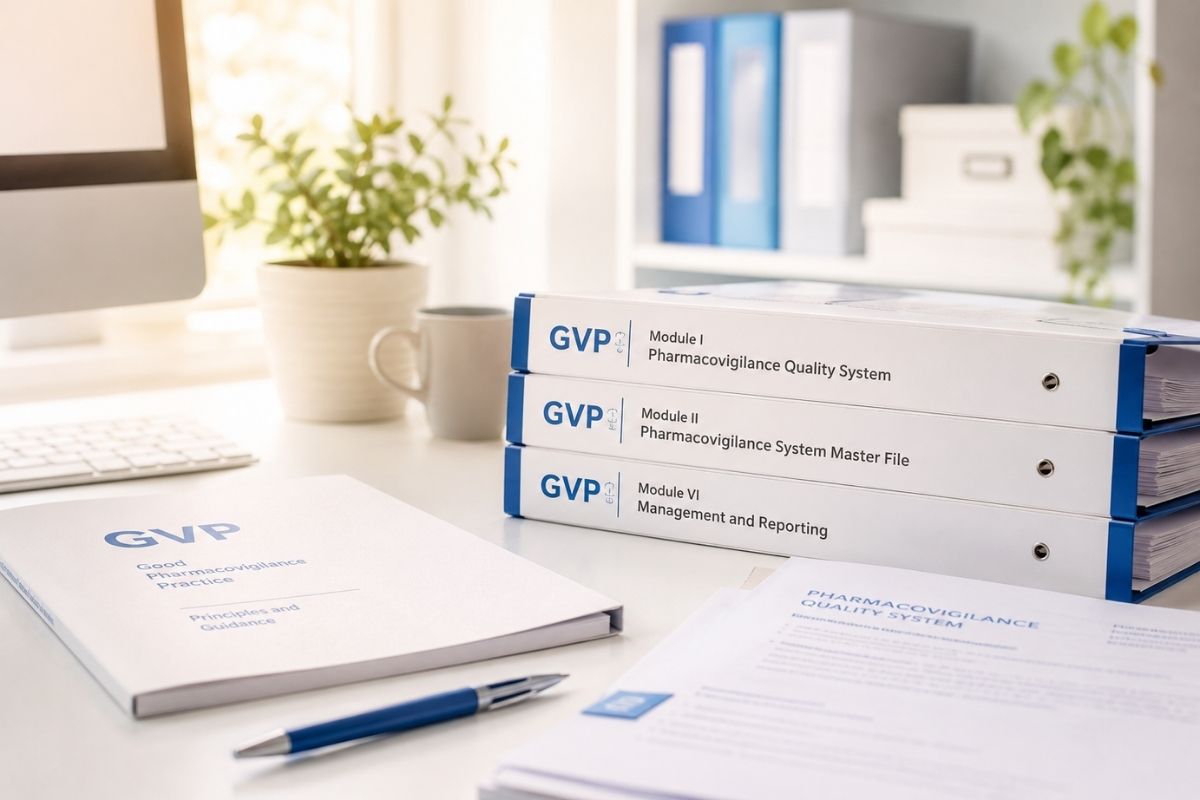
The GVPs do not constitute a single, static document. They are structured into modules and annexes, each dedicated to a specific area of pharmacovigilance: quality management, system organisation (PSMF), ICSR management, PSURs, signal detection and management, scientific literature monitoring, risk minimisation measures, audits, inspections, and more.
This modular architecture enables topic-based reading, but it also requires a cross-functional understanding: the requirements of one module cannot be isolated from the others without losing overall consistency. In practice, companies must comply with several applicable modules simultaneously, some of which may be revised on different timelines.
This evolving nature is a key consideration. Modules and annexes are periodically updated to reflect experience gained, regulatory developments, and the expectations of authorities. What was considered acceptable yesterday may now require adjustments to processes or documentation.
Precise Requirements… but Not Always Explicit on Implementation
The GVPs establish a demanding framework, but they do not always provide detailed operational guidance. They define principles, responsibilities and objectives while leaving MAHs considerable flexibility regarding the practical means of implementation.
This flexibility is intentional: it allows pharmacovigilance systems to be adapted to the size of the company, its geographical scope, product portfolio, and organisational model. However, it also creates grey areas, particularly when balancing global standardisation with local specificities, or deciding between insourcing and outsourcing activities.
The modules relating to PSURs, ICSRs and literature monitoring illustrate this complexity well: the expected outcomes are clearly defined, but the exact way to structure workflows, controls, interfaces and responsibilities is much less prescriptive. In such cases, a thorough understanding of the EMA’s Questions and Answers documents on these topics becomes essential.
Pharmacovigilance Outsourcing: A Responsibility That Cannot Be Delegated
A point regularly emphasised by competent authorities concerns oversight of outsourced activities. Outsourcing certain pharmacovigilance functions does not in any way reduce the responsibility of the Marketing Authorisation Holder (EU QPPV), nor that of the local representative in France. The GVPs clearly state that regulatory obligations remain fully borne by the company, even when service providers are involved.
In practice, this raises several operational questions:
- How can companies ensure that their internal procedures genuinely reflect GVP requirements, rather than simply mirroring those of the service provider?
- How should oversight, control and decision-making be documented beyond contractual agreements and statements of work?
- How can a company demonstrate during an inspection that outsourced activities are fully integrated into the overall pharmacovigilance system?
Inspectors do not merely verify the existence of contracts or procedures; they assess how GVP requirements are concretely embedded in day-to-day practices, including when multiple stakeholders are involved.
Pharmacovigilance Inspections by Competent Authorities: Revealing Consistency (or Inconsistencies)
Pharmacovigilance inspections conducted by the EMA or by national authorities acting on its behalf often represent a moment of truth for companies. They highlight not only formal compliance with requirements, but above all the overall consistency of the system.
Findings are not always the result of a lack of knowledge of the GVPs. More often, they stem from undocumented organisational decisions, overly generic procedures, or insufficiently clear articulation between different activities.
In this context, the ability to explain and justify decisions becomes crucial. Why was a particular process designed in this way? How are responsibilities allocated? How does the system meet GVP objectives given the company’s scope and organisation?
The Questions Companies Are Actually Asking
In practice, quality teams, pharmacovigilance departments and key interfaces are frequently confronted with very pragmatic questions:
- Do our internal procedures genuinely reflect the latest version of the applicable GVP modules?
- Are some requirements being fulfilled merely “out of habit”, without documented justification?
- Is outsourcing sufficiently governed in light of inspectors’ expectations?
- Do we have a clear understanding of the interfaces between modules (PSURs, ICSRs, signals, RMPs)?
- Can we demonstrate control of the system, rather than merely its existence?
These questions do not always have direct answers within the GVP texts themselves. They require both expert interpretation of the GVPs and a detailed understanding of how the organisation actually operates.
How Atessia Can Support You
In this evolving regulatory environment, Atessia supports pharmaceutical companies in clarifying and strengthening their approach to GVP compliance, without relying on standardised models.
In practical terms, this may include:
- Assessing the scope and applicability of GVP modules based on the company’s status, activities and product portfolio;
- Mapping pharmacovigilance processes and their interfaces (ongoing clinical trials, information flows from affiliates and distributors, interactions with quality teams), including outsourced activities;
- Reviewing or developing internal procedures aligned with both GVP requirements and actual operational practices;
- Preparing for inspections by focusing on consistency, traceability and the rationale behind organisational choices.
The objective is not to “do everything”, but rather to be able to explain why specific options have been selected and how they meet regulatory expectations.
A Structuring Framework That Must Be Put into Practice
The EMA’s GVPs are not merely a regulatory reference that needs to be kept up to date. They constitute a structuring framework that must be sustainably embedded within companies’ pharmacovigilance systems, including when activities are partially or fully outsourced.
In a context of increasingly demanding inspections, the key question is not simply whether GVP modules are known, but how they are understood, integrated, interconnected and justified throughout the organisation. This is a complex and often underestimated exercise, yet a strategic one for both compliance and the credibility of Marketing Authorisation Holders.
Jeanne Ducorroy
Consultante Sénior en Affaires Réglementaires & Directrice de la rédaction d'ATESSIA INTELLIGENCE
LEARN MORE ABOUT PHARMACOVIGILANCE WITH ATESSIA VIGILANCE’S SERVICES:
OUR SUBSIDIARY SPECIALIZED IN HEALTHCARE PRODUCT RISK MANAGEMENT AND SAFETY